11.3.09

Secondhand Sureshots - A DubLab Event


Let me start by saying this: I’ve never gone through a “spinning” phase. Don’t get me wrong – I love my vinyl collection as much as the next guy and a can respect a good sampling style. But I’ve never followed DJs, or really knew any of them by name. Recently, however, thanks to a more informed friend, my interest in the DJ process was sparked…

In early December, The Cinefamily at the Silent Movie Theatre on Fairfax (which deserves a great deal of praise on its own part) screened Secondhand Sureshots, a documentary that followed the process of four LA-based DJs. The film, which was only a little over an hour, approached the four subjects with a task: take five dollars, buy five used albums from a thrift store, and using only samples from those five albums, make a song. No further instrumentation was allowed – only samples. I was fascinated with the notion of such a puzzle and gladly accompanied the aforementioned friend to the screening, which was accompanied by live screen-printing and followed by a performance by two of the artists featured in the film.

Despite a few small issues, I found the film wholly engaging. I appreciated its brevity – the film was short not because of a lack of material, but because that’s all that really needed to be said, granted I did feel the time wasn’t always used in the best way (more to come later). Those expecting a deep exploration of the four artists’ styles will be let down. The film is pointed and focused, as it neatly follows the artists on the journey of their respective songs’ creation, from selecting the records to playing the finished product for each other. The structure was, pardon the pun, solid, as the film crafted a self-contained journey for the audience to experience. One of the most engaging sequences explored the artists’ selection process, uncovering answers to one of sampling’s biggest questions: How did you pick that? This particular sequence combined great pacing with a plethora of thorough interview footage to thoroughly introduce the audience to the artist without the use of weighty exposition. Through this sequence, I felt that I had truly connected with the artists themselves without a single moment of the standard, introductory interviews. It was this straight-forward structuring combined with a stylized execution that kept the film engaging.

Actually, what I found most admirable and intriguing in the film came out of the distribution of the final product. The artists compiled their four finished songs onto a single album, which was pressed as a 12" record. There were only four copies made. Graphic artist Brandy Flower then created a visually astounding cover using graphic "samples" from the original 20 albums from which the artists sampled (pictured to your left). Rather than sell these four, rare albums for exorbitant prices, each artist took their respective copy, placed a one dollar price tag in the corner, and secretly deposited them into the stores from which they purchased their five-dollars worth of sampling gold. No one knows where the albums are now. That act alone solidifies everything that I love about art in today's world - the ability to share your work in the purest of ways. The act makes their work ephemeral, accessible, but all the more special. There are no ridiculous profit margins, crazy copyright control (not that they could've licensed songs made of illegal samples), or snooty executives. It is simply art for art's sake, put back into the world to be enjoyed. And who really wants to argue with that??

While I adored the film's subject matter, and valued the conciscion and style of the film itself, I still wanted a bit more from the film as whole. Rather than watch nearly 20 minutes of the artists listening to their selected records, I would have preferred the time to be spent on the actual process. The film seemed to gloss over the physical creation of the songs, which was what had sparked my interest to begin with. I wanted to see the nuts and bolts of how the artists work – what beats and hooks they pick out, how they manipulate them, even what equipment they use – and yet, this whole area was barely touched. In fact, I felt a pang of dissatisfaction when the credits rolled because of this omission, as if I had been jipped out of seeing something magical take place. Granted, the film was made by DubLab, known for its work in the music industry, not necessarily in film endeavors. Taking that into consideration, I’d say the director can at least call the film a personal success.

Following the screening, the audience was encouraged to bring any media up to the stage – iPods, CDs, vinyl, etc. – and two of the artists featured in the film would create a song following the same rules as in the film. While I wasn’t too keen on the idea of waiting around for so long in silence, the free drinks added the necessary lubrication I needed to keep me hanging around. Three drinks and an hour-and-a-half later, the DJs finally had their songs ready for our aural delight. While the two songs were both remarkable considering the constraints, they were only, ultimately, two songs. In fact, I found it slightly unsettling that I had waited in the crowded courtyard of Cinefamily for so long and not be treated to a full set. Thus, despite promises of a third DJ coming in to do his own remix, my companions and I left immediately thereafter. Despite my particular dissatisfaction with both the film and the event as a whole, I still left the Silent Movie Theatre with that warm feeling of content that comes after witnessing a unique and exciting exhibition of art.


For those that were wondering, the four artists featured were Nobody, Ras G (whose dub-heavy, middle-eastern influenced style I fell in love with), Daedelus (signed to the always impressive Ninja Tunes), and J Rocc.

23.2.09

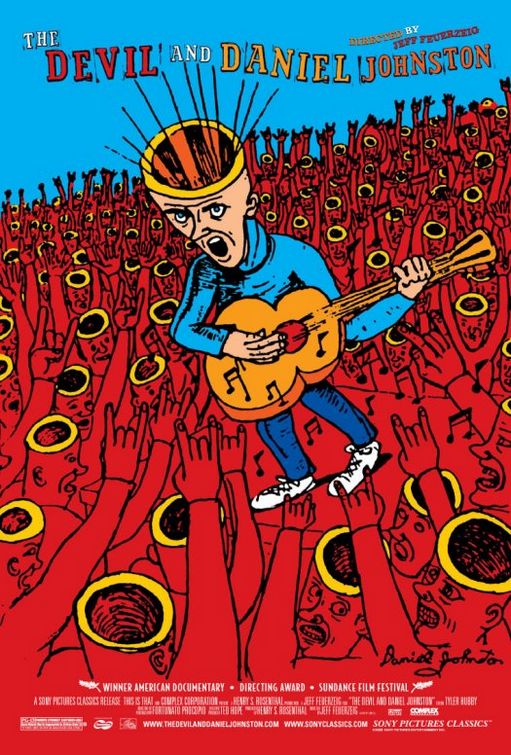
A Documentary Interlude - The Devil and Daniel Johnston

Well, ladies and gentleman, I suppose it's finally time to enter the blogosphere on my own free will. I did not oppose such a venture before, but rather, had no new remarkable media to speak of... until Friday night.

First, a main point about me that may have gotten lost in my ramblings and musings: I am, above all, a documentary filmmaker. Despite my love of music, involvement in installation, and penchant for specific sound design, my interest does not lie in the fictional realm. And while a great narrative film always inspires me, it's only in a truly original and well-crafted documentary that I really feel, for lack of a better phrase, swept away.

After a handful of persistent recommendations, I finally sat down to watch Jeff Feuerzeig's most recent film, The Devil and Daniel Johnston. I'm sure it goes without saying that there's a special place in my heart for a good music doc. This one, however, transcends such a label. Combining traditional interviews, a plethora of archive footage, and Daniel's own art, Feuerzeig allows the viewer into the tortured psyche of Daniel Johnston, a manic depressive, singer-songwriter and comic artist (though both of these labels feel a bit superficial). But before you roll your eyes and say, "Not another mad genius", WAIT. It really, truly, is not that kind of film, nor is Daniel that kind of person.

Johnston himself has garnered a mind boggling amount of praise from legends of the music industry, such as Sonic Youth's Thurston Moore, The Velvet Underground's Moe Tucker, and Spacemen 3/Spectrum's Pete Kember, to name a few. After rolling into Austin on a broken moped, straight off the carnival, a young Johnston made a name for himself around town, disemintaing his self-recorded tape, "Hi, How Are You?" (the cover of which may ring a few bells... yes, that is who you think it is). Not only his persistence, but his raw talent, caught the eye of no too few music appreciators, but, as with any great tragedy, Daniel never fully reaches a pinnacle of success.

Rather than simply show an aging artist coping with psychological turmoil, however, Feuerzeig crafts an intimate, sometimes uncomfortably so, portrait of a man who can't let go of his inner demons. Daniel's depression is voiced clearest in his own words. While he never sits down with Feuerzeig for an interview in the present day, the voice of his past echoes throughout the film, as Daniel kept a goldmine of audio journals from his brightest and darkest times. From Daniel's adolescent musings about wanting to girlfriend to the deeply disturbed rants about the devil's evil plight, Feuerzeig never leaves the audience questioning what is going on in Daniel's mind. Perhaps that very fact is what lifts the film out of the ranks of "music doc" or a "film about a crazy creative type". Feuerzeig forces the audience into Daniel's world, not simply by telling about it, but by forcing us all to experience, and ultimately empathize with Daniel's own turmoil. By the end of the film, there exists a feeling of loss and understanding at the notion of Daniel's deterioration. The viewer cannot sit passively and simply respond "Wow, what a shame", but rather, feels personally distraught, and even jipped, at Daniel's inability to function within society. And I'm sure there are those who would be turned off by this extreme intimacy.

More interesting, however, is the actual role of Daniel's artwork, as Feuerzeig uses the songs, drawings, and comic strips throughout the film to envelop the audience in Daniel's psyche. I could not commend this decision more, as the presence of the artwork allowed for Daniel to tell his own story from the depths of his own mind. What will ultimately arise with any audience, however, is the merit of Daniel's art. His music is often swept up in praise, and his self-recorded tapes are compared to early Bob Dylan and the lost Robert Johnson work. Is this praise often hyperbolic? Sure, but what praise really isn't, to some extent? And yet, Daniel's work possesses a raw power that is completely absent in modern music. The fact that he lacks a lot of technical proficiency matters very little, as this is no new concept to great music. Need I remind you of Bob Dylan, the Gun Club's Jeffrey Lee Pierece, or even Morrisey? Rather, Daniel's music registers as something completely unique and profound - an uncensored, unadultered look into his mind. Almost never is an audience given the chance to be truly effected by such true sentiments and emotion, and that, in itself, is worth praising, and the fact that Daniel allows the audience to have such an intimate experience is remarkable. Furthermore, he possesses an inherent knowledge of musical form, though he had little musical exposure, and no formal training, in his early life. If a human being is able to instinctively sit at a piano, organ, or guitar and craft a sonically compelling and emotionally moving song without so much as a friend to say "hey, that's on the right track", then that counts as genius in my book...

At the risk of sounding like a gushing fan, I could go on about the film for far too long, not just the subject matter, but Feuerzeig's artful direction as well. And as much as I would really like to keep explaining my view's on Daniel's representation, hypothesize as to why Feuerzeig made the cuts he did, or even explore the secondary characters (Daniel's extremely loyal ex-manager is almost as fascinating as Daniel himself), I realize that ultimately, this means nothing. Like Daniel Johnston himself, the film requires first-hand experience... I've had my say...

(But in case you need some music to really sell you on the idea, here's LastFM's sparse, but at least present, samplings of Daniel's work.)

13.2.09

No Wave, No How

New York City, 1978. Hundreds of kids with tight pants, long hair, and leather jackets line up outside of CBGBs to get a glimpse at punk rock sweethearts, the Ramones. But for a genre built on rebellion and anti-establishment sentiments, the line of patrons all seemed to resemble each other a little too closely. In the shop window across the street, one could even buy their very own leather jacket, already studded and patched to imperfection. The DIY, safety-pinned aesthetic could now be easily replicated and manufactured for your punk rock convenience. Let’s face it, my friends, punk had become a commercial tool, especially in New York City.

Enter No Wave.

Dissatisfied with the commercialism and monotony that had absorbed punk rock, and the imported New Wave genre that seemed saccharine in comparison, a group of artists decided they wanted nothing to do with said aberrations. The New York No Wave artists took the definition of music into their own hands, scrapping melody in favor of a tonal, textural approach to sound. Directly rejecting the confines of the “radio” song, No Wave artists approached music as a canvas for tones and sounds, rather than as a formula for commercial success. In fact, few No Wave artists actually recorded albums, but rather, played shows for each other, recorded compilations within the community, and hid in the confines of their basement level apartments. Their creations were not for the pleasure of an audience, but rather, for each others’ enjoyment. They treated their shows as a playdate for like-minded individuals, disillusioned with the state of art and music.

This is not to say that these shows consisted of a small group of people, sitting in the dark, listening to different frequencies at ear-shattering volumes. Rather, they were almost grandiose, theatrical, and above all, uncensored. Nevermind the bands that stood on stage, bopping their head to a 3-chord chorus; these were performance artists, taking every opportunity to mesh together theatre, rhythm, noise, and the favorite movement of the time, minimalism. No need for things like costumes, chords, or even a fully operating drum kit. Rather, the focus was on the bending and sculpting of sound, and the limitlessness of their creativity.


With so much creativity and disillusionment floating around these basement spaces, there was no way the movement could stick to just music. Before long, No Wave artists, such as Teenage Jesus, La Monte Young, and Swans, among others, banded together to make compilations, immersive theatrical pieces, and even films. No Wave music became No Wave art, and the only thread one had to follow was a yearning for creation paired with a rejection of the art world’s status quo. No Wave shows were anything but formulaic: shock value paired with societal critique, topped off with minimalism and a smack of musique concrete.

In some respects, Lydia Lunch was the darling of the scene. She entered the No Wave scene with her band, Teenage Jesus & the Jerks, determined to avoid the commercial art world. Often playing only a handful of 30-second songs, the band never recorded a complete album. That did not bar their influence, however, as the freeform onslaughts of sound took hold within the community, and are still sited as the influence for any number of noise, industrial, and experimental musicians. The band prided themselves on their departure from conventional music, as they often played instruments with any object within reach, such as cans, knives, or broken glass. They included no electronic instruments, as they felt that they lacked an organic component. Rather, the music was almost a rebellion against the audience: a short-lived ambush of multi-dimensional sounds, tones, and above all, attitude. After the band disbanded, Lydia went on to more collaborations, in music, poetry, and film, still focused on the same aesthetic principles of chaos, texture, and tone.

No Wave itself was short-lived, only thriving in New York basements for about five or so years, at least in it’s pure form. Shortly after their discoveries of sound’s limitlessness, the artists went down separate paths. Some, such as Lydia, stayed in the underground art world for the duration of their careers, clinging to the principle of personal art and rebellion against an audience’s power. Others, however (most notably the decade-spanning Sonic Youth), jumped ship for commercial success, trading their broken bottles for guitar picks and a chorus. This is not to say that the No Wave sentiment died completely. At the very least, the sell-outs helped to make it known, throwing chaotic breakdowns and musical explorations into studio albums. They embarked on a slow process of ripping up the public’s perception of music and rebuilding it in a more open, accepting form. But a money-spending, judgmental audience directly conflicted the No Wavers notions of art, which was not to be judged based on whether “people dug it”. The No Wavers had created their own paradox – keeping an art alive without anyone to observe it. And yet, they persevered, creating their own world of rejects, misfits, and rebels, creating art for each other and themselves alone…

But that’s never what makes the news, is it?