Well, ladies and gentleman, I suppose it's finally time to enter the blogosphere on my own free will. I did not oppose such a venture before, but rather, had no new remarkable media to speak of... until Friday night.
First, a main point about me that may have gotten lost in my ramblings and musings: I am, above all, a documentary filmmaker. Despite my love of music, involvement in installation, and penchant for specific sound design, my interest does not lie in the fictional realm. And while a great narrative film always inspires me, it's only in a truly original and well-crafted documentary that I really feel, for lack of a better phrase, swept away.
After a handful of persistent recommendations, I finally sat down to watc

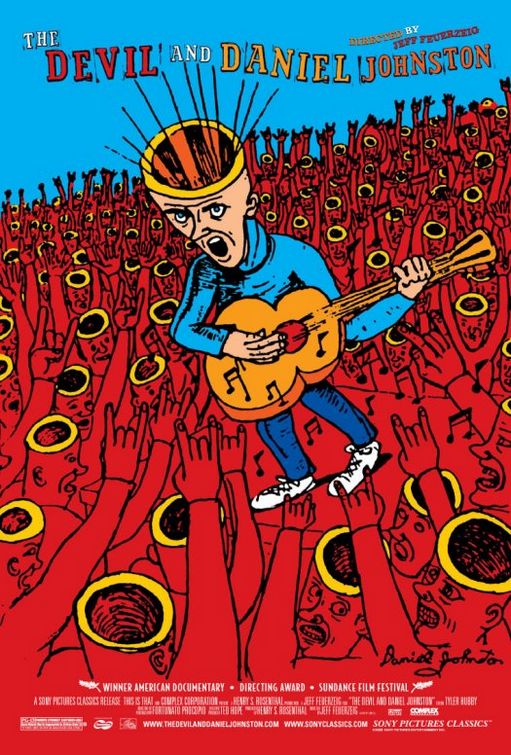
h Jeff Feuerzeig's most recent film,
The Devil and Daniel Johnston. I'm sure it goes without saying that there's a special place in my heart for a good music doc. This one, however, transcends such a label. Combining traditional interviews, a plethora of archive footage, and Daniel's own art, Feuerzeig allows the viewer into the tortured psyche of Daniel Johnston, a manic depressive, singer-songwriter and comic artist (though both of these labels feel a bit superficial). But before you roll your eyes and say, "Not another mad genius", WAIT. It really, truly, is not that kind of film, nor is Daniel that kind of person.

Johnston himself has garnered a mind boggling amount of praise from legends of the music industry, such as Sonic Youth's Thurston Moore, The Velvet Underground's Moe Tucker, and Spacemen 3/Spectrum's Pete Kember, to name a few. After rolling into Austin on a broken moped, straight off the carnival, a young Johnston made a name for himself around town, disemintaing his self-recorded tape, "Hi, How Are You?" (the cover of which may ring a few
bells... yes, that
is who you think it is). Not only his persistence, but his raw talent, caught the eye of no too few music appreciators, but, as with any great tragedy, Daniel never fully reaches a pinnacle of success.
Rather than simply show an aging artist coping with psychological turmoil, however, Feuerzeig crafts an intimate, sometimes uncomfortably so, portrait of a man who can't let go of his inner demons. Daniel's depression is voiced clearest in his own words. While he never sits down with Feuerzeig for an interview in the present day, the voice of his past echoes throughout the film, as Daniel kept a goldmine of audio journals from his brightest and darkest times. From Daniel's adolescent musings about wanting to girlfriend to the deeply disturbed rants about the devil's evil plight, Feuerzeig never leaves the audience questioning what is going on in Daniel's mind. Perhaps that very fact is what lifts the film out of the ranks of "music doc" or a "film about a crazy creative type". Feuerzeig forces the audience into Daniel's world, not simply by telling about it, but by forcing us all to experience, and ultimately empathize with Daniel's own turmoil. By the end of the film, there exists a feeling of loss and understanding at the notion of Daniel's deterioration. The viewer cannot sit passively and simply respond "Wow, what a shame", but rather, feels personally distraught, and even jipped, at Daniel's inability to function within society. And I'm sure there are those who would be turned off by this extreme intimacy.
More interesting, however, is the actual role of Daniel's artwork, as Feuerzeig uses the songs, drawings, and comic strips throughout the film to envelop the audience in Daniel's psyche. I could not commend this decision more, as the presence of the artwork allowed for Daniel to tell his own story from the depths of his own mind. What will ultimately arise with any audience, however, is the merit of Daniel's art. His music is often swept up in praise, and his self-recorded tapes are compared to early Bob Dylan and the lost Ro

bert Johnson work. Is this praise often hyperbolic? Sure, but what praise really isn't, to some extent? And yet, Daniel's work possesses a raw power that is completely absent in modern music. The fact that he lacks a lot of technical proficiency matters very little, as this is no new concept to great music. Need I remind you of Bob Dylan,
the Gun Club's Jeffrey Lee Pierece, or even Morrisey? Rather, Daniel's music registers as something completely unique and profound - an uncensored, unadultered look into his mind. Almost never is an audience given the chance to be truly effected by such true sentiments and emotion, and that, in itself, is worth praising, and the fact that Daniel allows the audience to have such an intimate experience is remarkable. Furthermore, he possesses an inherent knowledge of musical form, though he had little musical exposure, and no formal training, in his early life. If a human being is able to instinctively sit at a piano, organ, or guitar and craft a sonically compelling and emotionally moving song without so much as a friend to say "hey, that's on the right track", then that counts as genius in my book...
At the risk of sounding like a gushing fan, I could go on about the film for far too long, not just the subject matter, but Feuerzeig's artful direction as well. And as much as I would really like to keep explaining my view's on Daniel's representation, hypothesize as to why Feuerzeig made the cuts he did, or even explore the secondary characters (Daniel's extremely loyal
ex-manager is almost as fascinating as Daniel himself), I realize that ultimately, this means nothing. Like Daniel Johnston himself, the film requires first-hand experience... I've had my say...

(But in case you need some music to really sell you on the idea, here's LastFM's sparse, but at least present, samplings of Daniel's
work.)